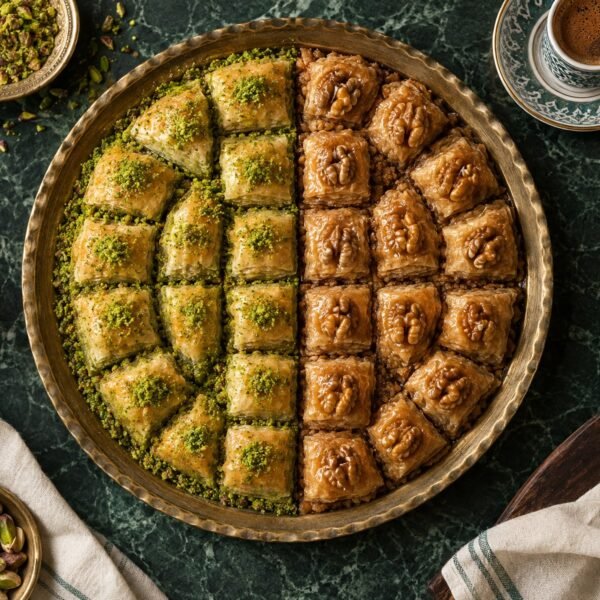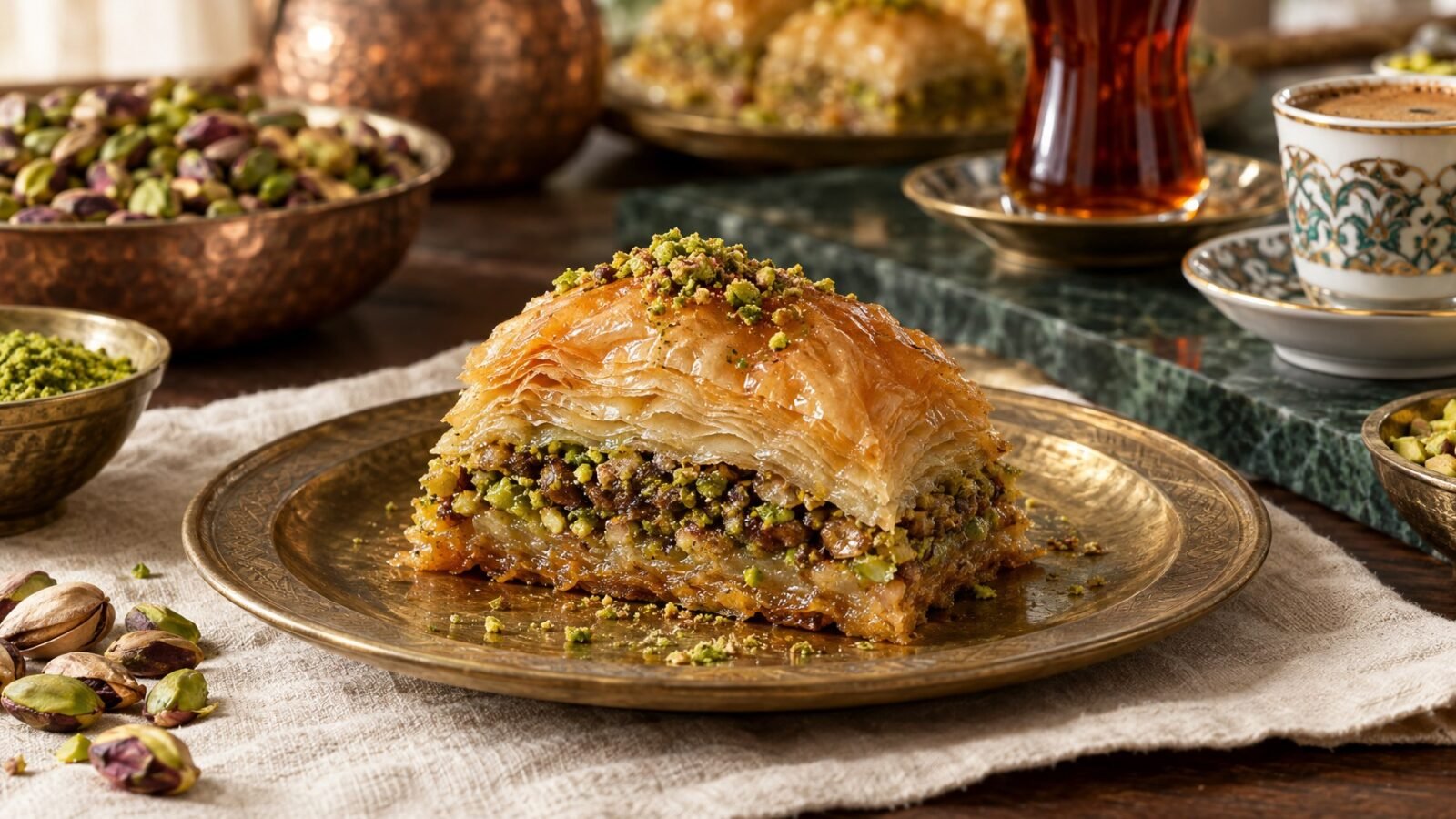
Baklava is a sweet pastry made from many paper-thin sheets of dough, layered with butter and chopped nuts, baked until golden and finished with syrup. It is one of the best-known desserts of Turkish, Middle Eastern, Balkan and Greek cuisine, and in Türkiye it is the dessert of holidays, weddings and welcoming guests.
In short
- Baklava is a pastry of many paper-thin dough layers, butter and chopped nuts, baked and soaked in syrup.
- The best-known Turkish versions are pistachio (Gaziantep style) and walnut.
- It contains wheat, milk and tree nuts, priority allergens in Canada.
- Serve it at room temperature with Turkish coffee or tea.
Baklava at a glance
| Question | Answer |
|---|---|
| Origin | Refined in Ottoman Istanbul; related traditions across Türkiye, Greece, the Levant and the Balkans |
| Main ingredients | Thin wheat dough, butter, nuts, sugar syrup |
| Most popular fillings | Pistachio and walnut |
| Texture | Crisp layers on top, a moist nutty centre, a syrup-soaked base |
| Served | At room temperature, 2–3 pieces per person |
| Pairs with | Turkish coffee or black tea |
| Allergens | Wheat, milk and tree nuts (check each label) |
What is baklava?
At its simplest, baklava is a tray of thin pastry sheets with a nut filling in the middle, cut into slices or diamonds, baked, and soaked with syrup. The result is a contrast you can hear: crisp, shattering layers on top, a dense nutty centre, and a sweetness that soaks into the bottom layers.
From that simple base, Turkish pastry makers have created dozens of variations — folded into triangles, rolled into fingers, twisted into rings, or served chilled with milk syrup. Our guide to the types of Turkish baklava explains the main ones.
What is baklava made of?
| Ingredient | What it does |
|---|---|
| Thin dough (yufka or phyllo) | Wheat flour dough rolled thin enough to see through. Many layers create the crisp texture. |
| Butter | Traditionally clarified butter, brushed or poured between layers for crispness and flavour. |
| Nuts | Pistachio, walnut, hazelnut or almond, chopped or ground. |
| Syrup | Usually sugar and water with a little lemon. Some styles use honey; Soğuk Baklava uses a milk syrup. |
Because of these ingredients, baklava contains wheat, milk and tree nuts, which are priority food allergens in Canada. Always check the label. See our allergen information.
What does baklava taste like?
Good baklava is sweet, buttery and nutty, but it should not be cloying. The top layers are light and crisp, the middle carries the flavour of the nuts, and the base is moist from the syrup. Pistachio baklava tastes bright and slightly floral; walnut baklava is deeper and earthier; hazelnut is toasty; almond is delicate.
Texture matters as much as flavour. A well-made piece shatters gently when you bite it, rather than bending or feeling greasy.
How is baklava traditionally prepared?
- The doughA simple wheat dough is rested, divided and rolled into very thin sheets.
- The layersSheets are stacked in a tray with butter between them, the nut filling is added, and more layers go on top.
- CuttingThe tray is cut into slices or diamonds before baking.
- BakingThe baklava bakes until golden and crisp throughout.
- SyrupSyrup is poured over; traditionally one of the two is hot and the other cooler, so the pastry stays crisp.
Read more about each step on our craftsmanship page.
Common Turkish baklava varieties
- Pistachio baklava (fıstıklı baklava) — the best-known Turkish style.
- Walnut baklava (cevizli baklava) — the classic of Anatolian homes.
- Şöbiyet — triangular parcels with pistachio and a creamy filling.
- Havuç Dilimi — long triangular “carrot slice” pieces.
- Fıstık Sarma — pistachio rolled in thin pastry.
- Soğuk Baklava — a modern, chilled version with milk syrup.
Pistachio versus walnut baklava
These are the two most popular fillings. Pistachio is richer and more aromatic, with a vivid green colour; walnut is milder and more robust. Many people serve both. Our pistachio vs walnut guide compares them in detail.
How baklava is served
Traditional baklava is served at room temperature, usually two or three pieces per person, on a small plate with a fork. In Türkiye it is often served after a meal or on its own with a hot drink. In Gaziantep, some people enjoy it with a scoop of kaymak (clotted cream) or ice cream.
Turkish coffee and tea pairings
Turkish coffee, whose culture and tradition UNESCO inscribed as intangible cultural heritage in 2013, is the classic partner: strong and unsweetened or lightly sweetened, it balances the syrup. A glass of black Turkish tea works just as well and is the everyday choice in many homes. Outside Türkiye, an espresso or a cup of unsweetened black tea is a good substitute.
Baklava as a gift
Bringing a box of baklava is a traditional way to visit family, congratulate someone or say thank you. It keeps for several days at room temperature (depending on the product) and is easy to share. Browse our gift boxes or read the baklava gift guide.
Frequently asked questions
Is baklava Turkish or Greek?
Both Turkish and Greek cuisines have long baklava traditions, as do many others in the former Ottoman world. The modern dessert took much of its form in Ottoman Istanbul. Read where baklava comes from.
Is baklava very sweet?
It is a sweet dessert, but well-made baklava balances sweetness with butter and nuts. Pistachio and walnut fillings temper the syrup.
Is baklava served hot or cold?
Traditional baklava is served at room temperature. Soğuk Baklava is the exception and is served chilled.
Does baklava contain nuts?
Almost always. The main exceptions are cheese-filled versions, which are still usually made in facilities that handle nuts.
Ready to taste it? Shop all baklava or start with the traditional classics.