
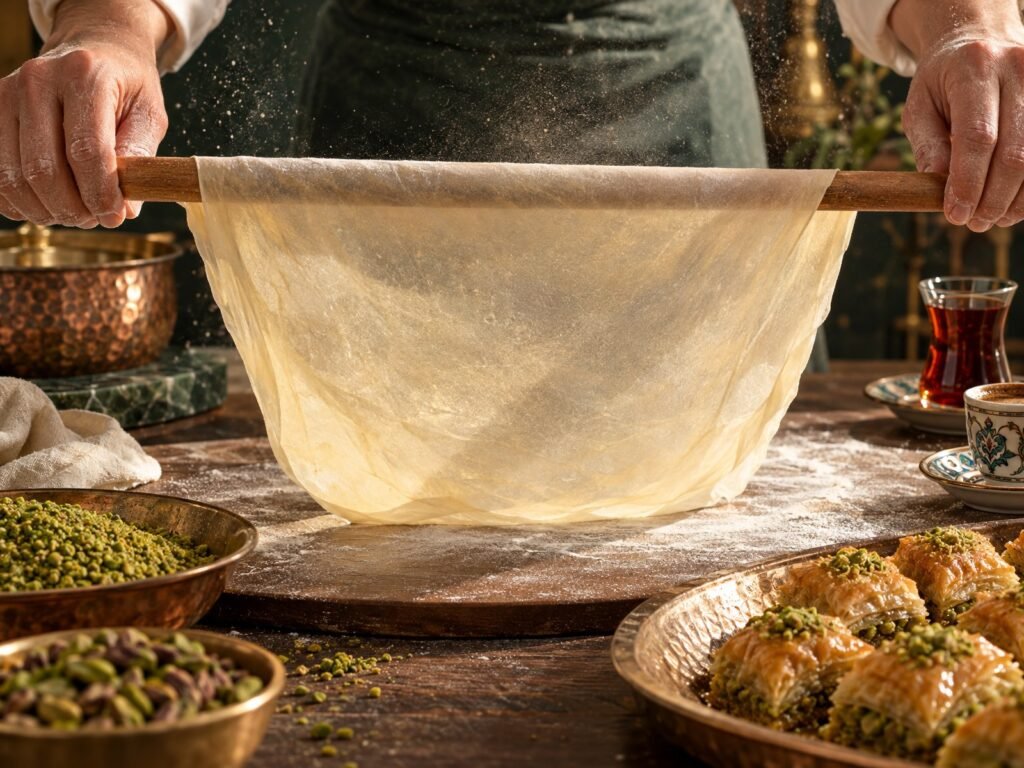
This page explains how traditional Turkish baklava is generally made. Each product page describes the specific product; production details for our products come from our supplier.
The traditional method
- Preparing the doughA simple dough of flour, water, egg and a little salt is kneaded until smooth and elastic, then rested so it can be stretched without tearing.
- Rolling thin layersThe dough is divided into small balls and rolled with a long, thin rolling pin, dusted with starch, until each sheet is thin enough to see light through. Skilled makers roll several sheets together to save time.
- LayeringSheets are laid in a tray one by one. Half go below the filling and half above it. The number of layers depends on the style and the maker.
- Clarified butterButter is clarified by gently melting it and removing the milk solids, which would otherwise burn. The pure butter fat is brushed or poured over the layers, giving crisp pastry and a clean, rich flavour.
- Preparing the nutsPistachios, walnuts, hazelnuts or almonds are chopped or ground to a size that suits the style — coarser for some regional baklava, finer for Gaziantep-style pistachio.
- Cutting before bakingThe tray is cut into slices or diamonds before it goes into the oven, so the butter can reach every layer and the pieces keep clean edges.
- BakingBaklava is baked until the layers are golden and crisp throughout. Too little time leaves the inner layers soft; too much darkens the nuts.
- Balancing the syrupA syrup of sugar, water and often a little lemon is poured over the baklava. Traditionally one is hot and the other cooler, so the pastry absorbs the syrup without turning soggy.
- Resting and presentationThe baklava rests so the syrup can settle, then is cut through and arranged for serving or packing.
Shapes that take extra skill
Specialties such as Şöbiyet, Midye, Bülbül Yuvası, Burma and Fıstık Sarma are folded, rolled or twisted piece by piece. Each shape changes the balance of crisp pastry and filling, and each requires its own technique.
What we look for in a finished baklava
- Layers that shatter lightly rather than bend.
- A filling generous enough to taste in every bite.
- Syrup that sweetens without pooling at the bottom.
- A clean butter flavour, never greasy.
- Even colour and neat edges.
Regional styles of making baklava
Technique varies across Türkiye. Gaziantep makers are known for extremely thin dough, many layers and a generous layer of finely ground pistachio. Home-style Anatolian baklava often uses walnuts and fewer, slightly thicker sheets. Specialty shapes such as Burma and Fıstık Sarma roll the dough around the filling instead of layering it.
Glossary of baklava terms
| Turkish term | Meaning |
|---|---|
| Yufka | Very thin sheets of wheat dough, the layers of baklava |
| Sade yağ | Clarified butter: butter with the milk solids removed |
| Şerbet | The sugar syrup poured over baklava after baking |
| Antep fıstığı | Pistachio associated with Gaziantep (Antep) |
| Boz iç | Early-harvested pistachio kernels, prized for their bright green colour |
| Kaymak | Thick clotted cream, sometimes served with baklava |
| Usta | A master craftsman, such as a master baklava maker |
Questions about how baklava is made
Why is baklava cut before baking?
Cutting before baking lets butter and syrup reach every layer and keeps the edges of each piece neat. Cutting after baking would crush the crisp layers.
Why does the temperature of the syrup matter?
When hot syrup meets cool pastry, or cool syrup meets hot pastry, the layers absorb the syrup gradually and stay crisp. If both are hot, the pastry can turn soggy.
How many layers does baklava have?
There is no fixed number. It depends on the style and the maker; Gaziantep-style baklava is known for using many very thin layers.
What is clarified butter and why is it used?
Clarified butter is butter with its water and milk solids removed. It can be heated without burning and gives baklava crisp layers and a clean, rich flavour.
Continue reading
- Our ingredients
- How to make baklava at home
- Types of Turkish baklava
- Shop all baklava